.png)
ALTA Surveys: What Florida Buyers and Developers Need to Know
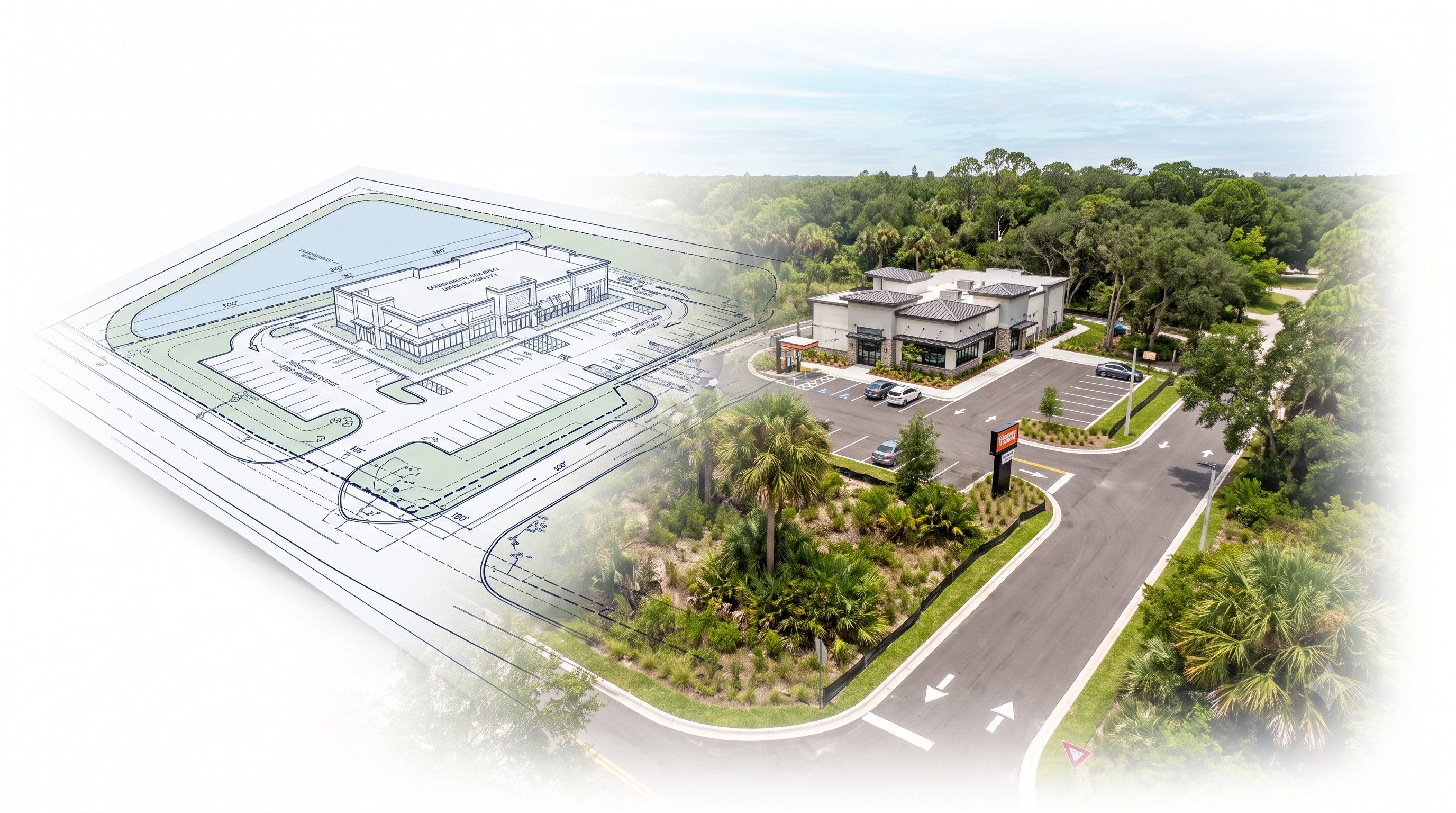
Picture this: you purchase a promising Florida development site. The site looks shovel ready, the title commitment appears clean, and the deal closes without a hitch. Then the real problems surface: the only driveway crosses a neighbor’s property, a utility easement cuts through the proposed building pad, or part of the parking lot falls outside the legal boundary. By then, what looked like a strong investment can quickly become a costly legal and development headache.
On paper, the deal may have looked fine. On the ground, it may not work.
An ALTA/NSPS Land Title Survey is where those two worlds meet. It takes the legal description and recorded title documents and compares them against the physical conditions observed at the property. For buyers, developers, lenders, and title insurers, that comparison can determine whether the intended project is financeable, buildable, and ultimately marketable.
The current 2026 ALTA/NSPS standards became effective on February 23, 2026. A complete ALTA survey includes required fieldwork, a plat or map, the selected optional Table A items, and the required surveyor certification. That sounds technical, but the business question is simple: does the property on the ground match the property the buyer believes it is acquiring?
Below are eight key legal and practical issues Florida buyers and developers should focus on:
1. Order the Right Survey Early. The survey request should expressly call for a 2026 ALTA/NSPS Land Title Survey and identify the requested Table A items. There are certain circumstances where clients may decide, as a business matter, to order a less expensive boundary survey at the outset and upgrade to an ALTA survey later, when institutional equity or a lender is involved. In either case, the type of survey and scope of the survey work (including any necessary Table A items for ALTA surveys) should be coordinated with the buyer, lender, title company, attorney, engineer, and surveyor before fieldwork begins. Waiting until the end of due diligence or ordering an ALTA survey too late can create an avoidable problem: the survey arrives after the buyer’s title-objection deadline, when there is little time or contractual leverage left to address what it shows.
2. Review the Survey and Title Commitment as One Package. A title commitment identifies recorded matters affecting title, while the survey shows where many of those matters sit on the ground. They should not be reviewed in separate silos. The surveyor should receive the current title commitment, the record legal description and the recorded easement and restriction documents. The final survey should then identify the applicable title exception numbers and show plottable easements, rights of way and other survey-related matters. A title exception that looks harmless in a document list can become a major development constraint once it is drawn across the site plan.
3. Confirm Both Legal and Physical Access. A parcel touching a road on an aerial map does not necessarily have adequate legal access. The survey should show the abutting right of way, curb cuts, driveways and observed access across the property. The title documents should establish whether the buyer has the legal right to use that access. This is especially important for assemblages, shared drive aisles, outparcels, private roads and properties that depend on cross-access through an adjoining shopping center or development. The survey can show physical conditions; the legal effect of those conditions must be analyzed separately.
4. Overlay Easements Against the Actual Development Plan. Utility, drainage, access, conservation, signage, parking and other easements may materially affect where improvements can be placed. The survey review should not stop at confirming that an easement is plotted. The easement needs to be compared against the proposed building footprint, parking fields, stormwater system, access points and future phases. If an easement crosses the planned construction area, the buyer may need a release, relocation, redesign, title coverage or a business decision to accept the limitation.
5. Take Encroachments Seriously, but Keep Them in Perspective. Fences, walls, roof overhangs, driveways, retaining walls, signs and other improvements may cross a boundary, setback, easement or right-of-way line. Not every encroachment is fatal, but each one should be understood before closing. Depending on the facts, the solution may involve removal, a license, an easement, an affidavit, title insurance coverage, a credit, a contractual cure or acceptance of the risk. The important point is to identify the issue while the parties still have time to allocate responsibility for it.
6. Choose Table A Items for the Deal, Not from Habit. Table A contains optional survey responsibilities and specifications. Common requests for Florida commercial transactions include flood-zone classification, gross land area, topography, zoning and setback information supplied through a zoning report, building dimensions, parking counts, evidence of underground utilities, off-site appurtenant easements, recent construction activity and a summary of certain potential encroachments and access concerns. No single Table A package is right for every transaction. A vacant development parcel, an operating shopping center and a waterfront assemblage require different information. Ordering unnecessary items can increase cost, while omitting a critical item can leave a meaningful diligence gap.
7. Understand What the Survey Does Not Prove. An ALTA survey is a powerful diligence tool, but it is not a zoning opinion, environmental report, engineering plan or guarantee that underground utilities have been located completely. The 2026 standards specifically caution that underground features cannot be accurately and reliably depicted in every case without excavation. Likewise, a flood-zone classification does not establish whether a property will flood, and a surveyor generally does not give legal opinions about ownership or the legal effect of an encroachment. The survey should be used together with zoning, environmental, engineering, title and legal review.
8. Account for Florida-Specific Conditions and Standards. Florida surveys must comply with the national ALTA/NSPS standards and applicable Florida surveying laws and professional standards. Where a state or local requirement is more stringent, the more stringent requirement applies. Waterfront boundaries, canals, shifting water lines, older plats, multiple legal descriptions and long-standing occupation lines can make a Florida survey more complicated than it first appears. Buyers should use a Florida-licensed surveyor who understands the local jurisdiction and should flag unusual property conditions at the time the survey is ordered, not after the first draft is delivered. Attorneys at Maher Law have significant experience in dealing with title issues relating to waterfront properties, including negotiating submerged land leases with the Florida Department of Environmental Protection and evaluating and underwriting riparian and littoral rights.
A clean survey does not automatically make a deal good, and a complicated survey does not automatically make it bad. The value of the survey is that it forces the parties to identify what physically exists, what is legally documented, what the title company will insure and what must be fixed or accepted before money and title change hands.
When ordered early and reviewed with the title commitment and development plan, an ALTA survey becomes more than a closing attachment. It becomes a roadmap for protecting access, preserving development flexibility and avoiding a surprise that may affect financing or future marketability.
The list above is not all-inclusive. For a transaction-specific ALTA survey and Table A checklist, or assistance reviewing survey and title issues affecting Florida commercial property, please reach out directly.
Disclaimer: This article is provided for general informational purposes only and does not constitute legal advice. Survey requirements and appropriate Table A items depend on the specific property, transaction documents, lender and title insurer requirements, and applicable law.